
Education does not stop after a bachelor’s degree. For many students and professionals in Pakistan, the next step is pursuing a postgraduate degree. These advanced programs are designed to build expertise in a specific field, expand career opportunities, and open doors to research or teaching roles.
With Pakistan’s growing demand for specialized healthcare professionals and subspecialists—particularly in fields like haematology, transfusion medicine, and bone marrow transplantation—postgraduate medical education has become essential rather than optional.
In this guide, we will explain what a postgraduate degree is, its types, benefits, requirements, with a special focus on medical and haematology pathways, including local and international training opportunities available in Pakistan, tuition costs and more, so you can make an informed decision about your future.
What is a Postgraduate Degree?
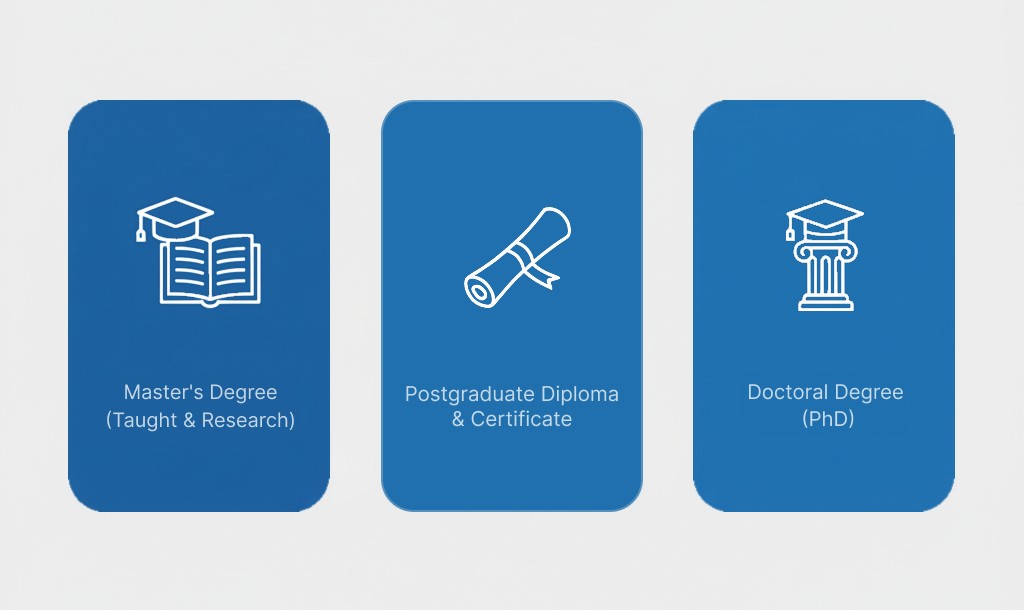
A postgraduate degree is any academic program pursued after a bachelor’s, offering advanced knowledge, research training, or professional skills. It includes postgraduate diplomas (PGDip/PGCert), master’s (MA, MSc, MBA, MS, MPhil), and doctoral degrees (PhD).
For medical graduates, postgraduate education includes:
- Clinical fellowships
- Residency programs
- FCPS / MD / MS / MPhil / PhD
- Postgraduate diplomas and international certifications
In Pakistan, medical postgraduate education is regulated by bodies such as:
- College of Physicians & Surgeons Pakistan (CPSP)
- Higher Education Commission (HEC)
- Pakistan Medical & Dental Council (PMDC)
For haematology, postgraduate study is essential to practice as a consultant haematologist, conduct laboratory diagnostics, or work in transplantation medicine.
Whether your goal is to deepen expertise, switch fields, or pursue research, a postgraduate path—diploma, master’s, or PhD—provides the structured curriculum or supervised research needed to advance academically and professionally.
Difference Between Undergraduate & Postgraduate
An undergraduate degree (BA, BSc, BBA, BS) is the first stage of higher education after high school, offering broad foundational knowledge through general courses and electives. In Pakistan, these programs usually last 2–4 years.
A postgraduate degree follows a bachelor’s and includes master’s, PhD, and postgraduate diplomas/certificates. These programs are specialized, research-driven, and advanced, requiring critical thinking, deeper subject focus, and often independent research.
| Undergraduate (MBBS / BDS) | Postgraduate (Medical Specialization) |
| General medical education | Focused clinical specialization |
| Rotations across disciplines | Dedicated training in one specialty |
| Limited independent decision-making | Supervised, advanced patient management |
| Entry-level doctor | Consultant-track physician |
👉 Example:
An MBBS graduate may study basic pathology, while a postgraduate haematology trainee focuses exclusively on:
- Blood disorders
- Coagulation abnormalities
- Bone marrow pathology
- Transfusion medicine
Key Differences in More Detail
- Depth vs Breadth: Undergraduate courses cover a broad base—general education plus major-specific classes. Postgraduate education narrows this, pushing for depth, specialization, and mastery in one area. For example, a BSc in Biology may cover many biology subfields; in postgraduate, you might focus on molecular biology or environmental genetics.
- Structure & Guidance: In undergraduate programs, classes are more structured: fixed timetables, regular lectures, tutorials, lab sessions, and continuous assessments. Professors guide students through the curriculum. Postgraduate programs, especially research ones, require more self-direction: you’ll often have fewer classes, more independent reading, and your work (thesis, research papers) is supervised but driven by you.
- Academic Expectations: Higher critical thinking, greater analytical skills, stronger writing, and more rigorous methodology are expected in postgraduate work. Often there is a thesis or dissertation requirement, peer-reviewed publications, and judged research contributions.
- Duration & Commitment: Undergraduate degrees in Pakistan often take 2-4 years, depending on discipline, full-time status, and whether the program is honors or professional. Postgraduate degrees vary: taught master’s may take 1.5-2 years, research master’s (MPhil) perhaps 2 years, and PhD often 3-5 years or more depending on research scope.
- Career Outcomes & Opportunities: An undergraduate degree usually qualifies you for many entry-level jobs. A postgraduate degree often opens doors to higher-level, specialized roles; research, teaching positions; roles in policy, academia, senior management; sometimes higher salary. Employers view postgraduate qualifications as evidence of deeper subject mastery, ability to think, research, and solve complex problems.
Types of Postgraduate Degrees
There are several types of postgraduate qualifications available in Pakistan and abroad. Understanding them helps you select the right path.
Master’s Degree (Taught & Research)
A Master’s degree is one of the most common forms of postgraduate study and comes in two main flavors: taught and research. A taught master’s (such as MA, MSc, MBA) is structured around lectures, seminars, fixed coursework, assignments, exams, and often a smaller dissertation or capstone project. Students follow a set curriculum and are more guided. A research master’s (such as MPhil or MS with thesis) places greater emphasis on independent research under a supervisor, often with fewer taught modules.
In Pakistan, universities typically require a bachelor’s with good grades (often CGPA ≥ 3.0/4.0) for admission into Master’s programs. For research master’s like MPhil, universities require supervision, often involve passing specific entry tests (GAT etc.), and include the development of a thesis or research project. These programs can last around 1.5 to 2 years full time for taught master’s, while research master’s may take somewhat longer depending on research scope.
In medicine, master’s-level postgraduate training often includes:
- FCPS (Fellowship of CPSP)
- MD / MS
- MPhil (Pathology / Haematology)
For haematology, pathways include:
- FCPS Haematology
- MPhil Haematology
- MD Haematology
These programs involve:
- Clinical rotations
- Laboratory diagnostics
- Research & thesis work
- Case-based learning
Postgraduate Diploma & Certificate
Postgraduate diplomas (PGD / PGDip) and certificates are shorter postgraduate qualifications aimed at specific professional or skill-based outcomes. They typically require a bachelor’s degree but are much shorter than a full master’s (often 6 months to 1 year for diploma, certificate even shorter). These offer targeted learning, sometimes in specialised areas like public policy, education, healthcare, management, or other professions.
In Pakistan, many institutions offer PGD and certificate programs designed for working professionals or those who want to enhance their qualifications without committing to a full master’s. For example, Allama Iqbal Open University offers PGDs in Early Childhood Education. The Postgraduate Certificate in Education (PGCert) is also common for teachers.
These programs are more flexible with scheduling, often evening or part-time, and less research-intensive, which makes them attractive for skill upgrades or shifting fields. The credits required are fewer, with coursework rather than thesis work being the main component.
For doctors seeking skill enhancement without full residency, postgraduate diplomas are valuable.
Relevant examples:
- PG Diploma in Transfusion Medicine
- PG Diploma in Clinical Pathology
- PG Certificate in Laboratory Haematology
These are especially useful for:
- General physicians
- Pathologists
- Medical officers working in blood banks
Doctoral Degree (PhD)
A PhD (Doctor of Philosophy) is the highest level of academic degree, focused almost entirely on original research. To gain admission into a PhD program in Pakistan, candidates usually need a Master’s or MPhil/MS degree with strong academic performance (e.g., CGPA ≥ 3.0/4.0 or First Division), and in many cases have to pass qualifying examinations such as GAT or GRE, plus an interview.
PhD programs demand a thesis/dissertation based on novel research, contribution to knowledge, and typically include supervisory oversight and sometimes residency or course work components. For example, Quaid-i-Azam University (QAU) requires PhD students to complete 18 credit hours of course work if they did not already complete equivalent course work.
In Pakistan, PhD duration is often 3 to 5 years (full time), though institutions sometimes allow up to 7 years (depending on discipline, progress, and thesis submission). The workload is rigorous, often requiring literature review, field/research work, publication in journals, and defense of thesis. The PhD is essential for many academic, research, and high-level policy roles.
A PhD is ideal for doctors interested in:
- Academic medicine
- Biomedical research
- Teaching & policy roles
In haematology, PhD research may focus on:
- Molecular haematology
- Leukemia genetics
- Stem cell biology
- Transfusion safety
Institutions like AKU, HEJ Karachi, and NIBD offer research-intensive doctoral pathways.
| Feature | Postgraduate Degree | Master’s Degree |
| Scope | Covers all studies after a bachelor’s, including Postgraduate Diplomas (PGD), Certificates, Master’s (MA, MSc, MBA, MS), MPhil, and PhD. | A specific type of postgraduate degree – mainly MA, MSc, MBA, MS, MPhil. |
| Duration | Varies widely: • PG Certificate: ~6–9 months • PG Diploma: 1 year • MA/MSc/MBA: 2 years • MS/MPhil: 2 years • PhD: 3–5 years | Typically 1.5 – 2 years in Pakistan. Examples: • MA English (Punjab University, 2 years) • MBA (IBA Karachi, 1.5–2 years) |
| Credit / Academic Load | Depends on qualification: • PG Diploma: ~24 credit hours, coursework only • MS/MPhil: 30 credit hours (24 coursework + 6 thesis) • PhD: 48+ credit hours including research and thesis | Requires 30–36 credit hours. Example: MS Computer Science at NUST: 24 credit hours coursework + 6 thesis credits. |
| Focus / Nature of Study | Can be professional (skills-based PGD in areas like Early Childhood Education at AIOU) or research-intensive (MPhil/PhD). | Focuses on advanced subject knowledge, with a mix of coursework + research. Example: MSc Economics at Quaid-i-Azam University emphasizes theory plus research project. |
| Examples in Pakistan | • PGD in Education (AIOU) • PGD in Clinical Psychology (Punjab University) • MS Biotechnology (HEJ Karachi University) • MPhil Education (LUMS) • PhD Physics (QAU Islamabad) | • MBA (IBA Karachi) • MSc Physics (Punjab University) • MA English (Karachi University) • MS Data Science (FAST NUCES) |
| Admission Requirements | • PGD: Bachelor’s degree with 2nd division acceptable in most universities. • MS/MPhil: Minimum CGPA 2.5–3.0/4.0, plus GAT General (HEC requirement). • PhD: Minimum CGPA 3.0/4.0 in MS/MPhil + GAT Subject or GRE + research proposal. | • Bachelor’s degree (14 or 16 years, depending on program) with minimum 2nd division or CGPA 2.5–3.0/4.0. Some master’s programs (MBA at LUMS/IBA) also require GMAT/GRE or university entrance tests. |
| Purpose / Career Outcomes | • Short PGDs/Certificates: quick career enhancement, teaching credentials, skill upgrades. • MS/MPhil: stepping stone to PhD, eligibility for university teaching/research posts. • PhD: essential for full faculty positions, advanced research careers, and high-level policy roles. | • Master’s (MA/MSc/MBA) improves job prospects, offers promotion opportunities, and prepares for higher academic study. Example: MBA from IBA/LUMS often leads to senior corporate roles. |
Postgraduate Medical Specialization in Haematology (Pakistan)
Haematology is a highly specialized medical field dealing with diseases of blood, bone marrow, and lymphatic systems.
Local Training Pathways
Key institutions offering advanced haematology training include:
- NIBD (National Institute of Blood Diseases), Karachi
- Aga Khan University (AKU)
- Dow University of Health Sciences
- CPSP-accredited centers
Areas of Specialization
- Clinical Haematology
- Laboratory Haematology
- Transfusion Medicine
- Bone Marrow Transplantation (BMT)
- Coagulation Disorders
NIBD, for example, provides structured fellowships in:
- Clinical Haematology
- BMT
- Transfusion Medicine
- Cytogenetics & Flow Cytometry
International Courses to Enhance Haematology Expertise
For medical professionals aiming to strengthen global credibility, international certifications are highly recommended.
Popular International Qualifications
- MRCP (UK) – foundational for internal medicine before haematology specialization
- FRCPath (UK) – gold standard for pathology & haematology
- European Hematology Association (EHA) Courses
- American Society of Hematology (ASH) Certification Programs
- Postdoctoral Fellowships (UK, USA, Middle East)
Skill-Based International Training
- Flow cytometry workshops
- Molecular diagnostics courses
- BMT observerships
- Transfusion safety & quality programs
These enhance:
- Diagnostic accuracy
- Research publication potential
- International employability
Admission Requirements:
For postgraduate medical programs:
- MBBS / equivalent recognized by PMDC
- House job completion
- Passing FCPS-I / entry exams
- Interviews & supervisor approval
For international courses:
- English proficiency (IELTS/OET)
- Licensing exams (PLAB, USMLE if applicable)
Postgraduate Degree Requirements in Pakistan
To gain admission into postgraduate programs in Pakistan, applicants generally must satisfy a mix of academic, testing, documentation, and sometimes research or work-experience criteria. Below are the detailed requirements, along with examples of how different universities enforce them.
1. Academic Qualifications & Education Years
- 16 years of education is often mandatory, meaning a 4-year bachelor’s degree (BS, BE, etc.) or an equivalent qualification recognized by the Higher Education Commission (HEC). For research master’s or PhD, many universities require an MS/MPhil (18 years total).
- Minimum CGPA or percentage prerequisites: For MS/MPhil or PhD, universities like NUST require a minimum CGPA of 3.0/4.0 in the relevant field, or first division under the annual system.
- Some degree programs (e.g. Bahria University) accept a lower threshold for less research-intensive master’s: CGPA 2.00/4.0 or 50% marks in non-CGPA degrees.
2. Entry / Admission Tests & Aptitude Exams
- NTS GAT (General or Subject): Frequently required for MS, MPhil, PhD admissions. HEC’s policy mandates passing the GAT General or Subject with a minimum score (often ≥ 50%) for many postgraduate programs.
- HEC’s HAT (Higher Education Aptitude Test): Increasingly adopted; for example, NUST accepts HAT as part of its admission criteria in certain Master’s programs, or as an alternative to GAT/GRE.
- GRE / other standardized tests: For some postgraduate programs—especially for those intended to align with or compete globally—GRE (General) is accepted. NUST, for instance, in some disciplines, allows GRE (General) as an alternative.
3. Research Proposal / Statement of Purpose (SOP)
- For research-oriented postgraduate programs (MPhil, MS thesis track, PhD), universities require a research proposal or synopsis at the time of application. The proposal should outline intended research questions, methodology, literature, timeline. NUST, for PhD candidates, mandates that the candidate defines the area of research and gets the proposed supervisor approved.
- A Statement of Purpose (SOP) is also commonly required, detailing the applicant’s academic background, career goals, justification for choosing that field or university. It helps in selection especially when competition is high.
4. Letters of Recommendation & Other Documents
- Usually 2–3 letters of recommendation, typically from professors or academic supervisors who know the applicant’s work and can comment on research potential, academic performance, and personal qualities. These are essential for master’s vs postgraduate vs PhD admissions.
- Other documentation includes: official transcripts, degree certificates (BS/BA), equivalence certificate (if degree is from foreign institution), sometimes employer “No Objection Certificates” (NOCs) if the applicant is employed. For example, HITEC University requires a NOC if the candidate is working.
5. Language Proficiency (if applicable)
- If applying to universities where English is required (especially for foreign programs, or even local institutions with English medium), submitting IELTS, TOEFL, or other recognized English language test scores may be required.
- Also, some Pakistani universities accept national/international publications in English, or prior education in English, as proof.
6. Additional Factors & Specific University Policies
- Some universities require credit hour minimums: e.g. NUST requires that MS/MPhil applicants have completed either ≥ 30 credit hours of coursework or… coursework + thesis components.
- First Division requirement: For certain HEC scholarships or overseas scholarships, only applicants with “First Division” (or no second/third divisions) in previous degrees are eligible.
- Age limits or maximum acceptable divisions in past degrees may be enforced in some scholarships or special programs.
Duration & Structure of Postgraduate Programs
The duration and structure of postgraduate programs in Pakistan vary depending on the type of degree (Postgraduate Diploma/Certificate, Master’s, MPhil, PhD), and whether it is taught, research, or mixed. Below are the typical timelines, credit requirements, and structural components, along with examples from Pakistani universities.
Typical Duration by Degree Type
- Postgraduate Diploma / Certificate: Usually 6 months to 1 year. These are more coursework-based with little or no thesis component.
- Master’s (Taught / Research / Mixed): Generally 1.5 to 2 years full-time for most taught master’s degrees (MA, MSc, MBA). Research or thesis-based master’s may lean toward the upper bound or sometimes slightly more if part-time.
- MPhil / MS (Research Master’s): Standard duration is 2 years minimum. Universities may allow up to 4 years (depending on the student’s pace, part-time / full-time status, and if coursework + thesis work is involved). For example, IOBM’s MPhil in Education requires 24 credit hours of coursework + 6 credit hours of thesis and spans 1.5 to 4 years depending on completion speed.
- PhD: Minimum about 3 years, often stretching to 5 years or more, especially if research is complex, field-work is required, or if there are publication requirements. Some policies allow up to 8 years for part-time or delayed completion. For instance, UHS policy indicates minimum 3 years PhD duration, with maximum extensions possible.
Structure & Components
Postgraduate programs usually follow a combination of coursework modules, independent / supervised research, and thesis or dissertation submission, with variations per degree type.
- Coursework Modules
- Master’s and MPhil/MS programs include fixed credit hour courses; these could be foundational or advanced courses in the field.
- According to HEC’s Minimum Criteria for MS/MPhil, candidates must complete at least 30 credit hours of coursework (or equivalent) before a thesis, or 24 credit hours under some programs.
- LUMS, in its MPhil Education Leadership & Management program requires 36 credit hours total, which include 27 credit hours of taught / interdisciplinary coursework + 9 credit hours of capstone / practicum / field work.
- Master’s and MPhil/MS programs include fixed credit hour courses; these could be foundational or advanced courses in the field.
- Research or Thesis Component
- For MPhil / MS (research track) and PhD, after completing coursework, students typically prepare a thesis (sometimes called a dissertation) based on original research. This is supervised by a faculty member.
- For example, AKU’s MPhil in Biological & Biomedical Sciences requires 25 credits of coursework + 6 credits of original research, followed by thesis defense.
- For MPhil / MS (research track) and PhD, after completing coursework, students typically prepare a thesis (sometimes called a dissertation) based on original research. This is supervised by a faculty member.
- Comprehensive / Qualifying Examinations
- Many PhD programs in Pakistani universities require a comprehensive exam (written + oral) within the first 1-2 years of admission. If the student fails, they may get retries; failure can lead to cancellation of registration. University of the Punjab, QAU, and others follow this.
- Many PhD programs in Pakistani universities require a comprehensive exam (written + oral) within the first 1-2 years of admission. If the student fails, they may get retries; failure can lead to cancellation of registration. University of the Punjab, QAU, and others follow this.
- Residency / Minimum On-Campus Requirements
- Some PhD programs require a period of residency (minimum full-time presence) especially during the intensive research phases. For instance, certain HEC policies and university rules demand that doctoral candidates remain registered full-time for certain semesters.
- Some PhD programs require a period of residency (minimum full-time presence) especially during the intensive research phases. For instance, certain HEC policies and university rules demand that doctoral candidates remain registered full-time for certain semesters.
- Credit Hour and CGPA Requirements
- Coursework and thesis credit hours are defined differently per institution, but typically an MS/MPhil will require ~30 credit hours (coursework + thesis). PhD programs might require ~ 18 credit hours of coursework (if the student already has MS/MPhil) plus a substantial thesis/research credit requirement. Example: PIDE’s PhD Development Studies requires 66 total credit hours, 18 for coursework and 48 for thesis.
- Minimum CGPA (often 2.5 or 3.0/4.0 depending on program) during coursework is required to move to the research/thesis phase. Example: LUMS MPhil requires maintaining CGPA ≥ 2.50 during each semester.
- Coursework and thesis credit hours are defined differently per institution, but typically an MS/MPhil will require ~30 credit hours (coursework + thesis). PhD programs might require ~ 18 credit hours of coursework (if the student already has MS/MPhil) plus a substantial thesis/research credit requirement. Example: PIDE’s PhD Development Studies requires 66 total credit hours, 18 for coursework and 48 for thesis.
Costs & Scholarships for Postgraduate Studies in Pakistan
Pursuing a postgraduate degree incurs several costs beyond tuition — courses and fees, research bench fees, living expenses, etc. At the same time, many scholarship and financial assistance options exist to offset these costs, especially for postgraduate degree applicants in Pakistan.
Tuition & Associated Costs in Pakistan
Here are more precise examples from Pakistani institutions to illustrate how tuition and fees can vary by program type, university type, and specialization.
- NUST (Islamabad): Postgraduate tuition is lower for locals than internationals, but extra costs like bench/research fees, summer credits, and registration add up. PhD students pay bench fees if research continues beyond 3 years/6 semesters.
- UMT (Lahore): Private university postgraduate fees often reach PKR 500,000–700,000+ per year, especially for lab-intensive or business programs. Social sciences cost less than engineering/tech fields.
- Greenwich (Karachi): Graduate fees are per credit hour (~PKR 8,470 for master’s), plus exam, lab, and registration charges. MPhil/PhD credit costs are higher.
- Virtual University (VU): Much lower per-credit fees than private universities, but overall costs still build up over multiple semesters.
- Public Universities: Subsidized for locals, but “self-supporting/evening” programs cost more due to extra operational expenses (e.g., Punjab University).
- Other Costs to Factor:
- Bench / maintenance / lab fees for research programs.
- Thesis / dissertation evaluation fees.
- Semester-registration fees, examination fees, library / lab charges.
- Living costs (housing, transport, food), which vary greatly with city (Karachi, Lahore, Islamabad being more expensive).
- Bench / maintenance / lab fees for research programs.
Given all that, the typical tuition range you provided (local universities PKR 150,000–400,000; private PKR 300,000–800,000) is valid for many programs, but for lab-intensive, private, or foreign programs, the cost can go higher (PKR 800,000-1,200,000+ depending on program and university) once additional fees are included.
Scholarships & Financial Aid
To help with these postgraduate degree costs, Pakistan offers several scholarship and funding routes. Key options include:
- HEC Scholarships & Grants
- HEC (Higher Education Commission) provides merit-based and need-based schemes. For example, the HEC Overseas PhD Scholarship (for faculty) has requirements like MS/MPhil equivalence, age limits, etc.
- Financial breakdowns from HEC for some grants include stipends, tuition fee waivers, accommodation or hostel allowances. For instance, the OIC (Organisation of Islamic Cooperation) scholarship financial breakdown shows annual tuition, living stipend, hostel and book allowances.
- HEC (Higher Education Commission) provides merit-based and need-based schemes. For example, the HEC Overseas PhD Scholarship (for faculty) has requirements like MS/MPhil equivalence, age limits, etc.
- University Scholarships
- Private institutions like UMT, LUMS, IBA often have internal scholarship or financial assistance programs, which might cover part or full tuition for deserving students based on merit or financial need.
- Some universities offer special quotas or waivers for students from remote areas, underprivileged backgrounds, or minority groups.
- Private institutions like UMT, LUMS, IBA often have internal scholarship or financial assistance programs, which might cover part or full tuition for deserving students based on merit or financial need.
- International Scholarships & Grants
- Programmes like Chevening, Fulbright, Erasmus+ are open to Pakistani postgraduate students. These often cover tuition, travel, living costs abroad.
- Bilateral / multilateral aid scholarships: for example, the HEC Commonwealth Scholarship or OIC Scholarship. Applicants typically need strong academic records and passing relevant tests.
- Programmes like Chevening, Fulbright, Erasmus+ are open to Pakistani postgraduate students. These often cover tuition, travel, living costs abroad.
- Special/Targeted Scholarships
- Scholarships for women, minorities, and students from less developed regions. E.g., British Council’s “Scotland Pakistan Scholarships for Young Women and Girls” scheme offers tuition fee support for certain fields of study in HEC-recognised universities in Pakistan.
- Provincial HEC offices or Sindh HEC, etc., also sometimes run scholarship programs for PG students in their regions.
- Scholarships for women, minorities, and students from less developed regions. E.g., British Council’s “Scotland Pakistan Scholarships for Young Women and Girls” scheme offers tuition fee support for certain fields of study in HEC-recognised universities in Pakistan.
- Funding for Research / Bench Fees
- In many research-master’s or PhD programs, universities or external bodies provide bench grants or research funds to help with lab consumables, fieldwork, or publishing costs. Where scholarship does not cover full costs, these research-grants help bridge the gap.
Practical Tips to Manage/Postgraduate Degree Costs
- Choose public or HEC-recognized institutions: Costs are often substantially lower.
- Apply for scholarships early: Many scholarship applications are due well before admissions.
- Look for internal departmental funding or assistantships: Some MS/MPhil/PhD programs offer the chance to work as research/teaching assistants, which may come with a stipend or fee waiver.
- Consider program mode (part-time / weekend / online): These sometimes cost more per credit or have additional fees, but may allow you to work alongside study to offset living costs.
- Budget for hidden costs: Lab fees, books, travel, thesis binding, publication fees, etc.
Benefits of a Postgraduate Degree
Pursuing a postgraduate degree in Pakistan offers many advantages beyond the basics. Adding local data and examples makes these benefits clearer for students considering postgraduate programs in Pakistan.
Career Scope & Specialized Roles
- Graduates with postgraduate degrees are in demand in specialized roles. For example, a Master’s in Data Science or Computer Science is increasingly valued by tech-startups, telecommunications firms, and financial services companies. According to Edify.pk, roles like data scientist, AI specialist, and cybersecurity analyst are growing rapidly, especially in hubs like Karachi, Lahore, and Islamabad.
- Industries such as environmental science, public health, and education policy are also expanding. Graduates with MA/MSc or MPH degrees at institutions like Aga Khan University, Dow University of Health Sciences, and COMSATS are getting roles in NGOs, government health departments, and research institutions.
- For MPhil students, opportunities exist in policy analysis, consulting, academia and research, both locally in think-tanks (e.g. PIDE Islamabad) and abroad. Uchenab University’s website says MPhil programs strengthen analytical and research skills, making graduates more competitive in both academic and corporate sectors.
Research Opportunities
- Institutions like Pakistan Institute of Development Economics (PIDE) are major postgraduate research hubs. They allow students to participate in policy-oriented research and collaborate with government bodies, NGOs, and international partners.
- In medical fields, postgraduate degree holders (residents) gain access to clinical research, laboratory work, and publications in medical journals. For instance, Aga Khan University’s medical residents receive structured training and are offered a salary plus benefits during their residency.
Salary Impact & Financial Gains
- Data from TimeDoctor / SalaryExplorer shows that professionals in Pakistan with postgraduate degrees enjoy around 29% higher salary than those with only bachelor’s degrees.
- In medical residencies, postgraduate medical residents in Pakistan (first years) earn between PKR 50,000-100,000 per month, with median in many cases around PKR 75,000/month. Senior resident levels earn significantly more.
- Beyond medicine, completing an MS/MPhil or MBA from reputed institutions like IBA, LUMS, NUST etc often leads to promotions and access to managerial or senior specialist roles, which come with higher pay scales. For many sectors, having a postgraduate degree becomes a differentiator during hiring and appraisal.
Networking, Recognition & Academic Prestige
- Postgraduate studies often allow you to build strong academic and professional networks. In research-intensive institutions like PIDE, University of the Punjab (through centres like CHEP: Centre for High Energy Physics) etc., students work with experts, attend workshops, publish papers, and may collaborate on funded projects. These connections can lead to post-doctoral opportunities, research grants, or academic jobs.
- Having a postgraduate degree increases credibility. Employers, especially multinational companies operating in Pakistan, often prefer applicants with advanced qualifications, because they are assumed to have better critical thinking, research, and analytical skills. This is part of the postgraduate degree benefits sought by many in Pakistan.
Benefits of a Postgraduate Degree in Medical & Haematology:
- Consultant-level practice
- Higher salary & professional autonomy
- Eligibility for BMT units, blood banks, tertiary hospitals
- Research publications & academic roles
- International migration pathways
In Pakistan, trained haematologists are in critical demand, particularly for oncology support, transfusion services, and transplantation medicine.
Challenges of Postgraduate Study
While postgraduate study offers many benefits, in Pakistan many students experience significant obstacles. Understanding these challenges — in time, finances, work-study balance, institutional support, and academic structure — can help prospective students prepare better.
- Time Commitment & Delays: Programs often extend beyond the minimum years due to slow supervisor feedback, thesis corrections, bureaucratic delays, and overlapping coursework or lab/fieldwork deadlines.
- Work-Study Balance: Many students juggle jobs, family duties, and commuting with academic demands. Lack of flexible schedules especially affects working and rural students.
- Financial Pressure: High tuition, bench fees, lab/research costs, travel, and publishing expenses create heavy burdens. Scholarships are limited and rarely cover living costs.
- Institutional & Academic Issues: Weak supervision, delayed evaluations, poor lab facilities, and lack of training in research methods or access to journals hinder progress.
- Mental Health & Motivation: Stress, anxiety, and burnout are common due to workload, finances, and family responsibilities. Procrastination, low confidence, and uncertainty about research paths add to pressure.
- Highly Competitive Entry: Admission into FCPS, MD, and MS programs is extremely competitive, with limited seats and rigorous entry examinations.
- Limited Accredited Training Seats: The number of recognized training positions in specialized medical fields, including haematology, remains limited compared to demand.
Despite these challenges, structured institutions like NIBD offer focused mentorship, hands-on clinical exposure, and access to advanced diagnostic and therapeutic procedures, helping medical postgraduate students navigate training more effectively.
Postgraduate Degree Programs in Pakistan
Pakistan has a strong network of universities offering diverse postgraduate programs in Pakistan, ranging from postgraduate diplomas to PhDs, across fields including business, health sciences, engineering, social sciences and research studies. Here are leading institutions and some of the programs they offer, to give you a fuller picture of what you can expect locally.
Key Universities & Their Program Offerings
- NIBD (National Institute of Blood Diseases & Bone Marrow Transplantation), Karachi
NIBD offers specialized postgraduate training and fellowship programs, particularly in haematology, bone marrow transplantation (BMT), clinical haematology, laboratory haematology (including cytogenetics, coagulation, blood banking, flow cytometry). These are aimed at those completing internal medicine or paediatrics and seeking specialization. - NUST (National University of Sciences & Technology), Islamabad
NUST provides more than 60 streams of master’s programmes across disciplines: engineering & technology (electrical, mechanical, computer science, AI, etc.), natural sciences, social sciences, architecture, business studies. It also offers MS, MPhil, and PhD in many of these areas. For example, the School of Electrical Engineering & Computer Science offers MS Data Science, MS AI & Autonomous Systems. - Aga Khan University (AKU), Karachi
AKU’s Medical College and Graduate Medical Education departments offer a wide array of postgraduate and research programs, including MS in Public Health, Epidemiology & Biostatistics, Health Policy & Management, Health Data Sciences; MPhil and PhD in Biological & Biomedical Sciences. - IBA (Institute of Business Administration), Karachi
IBA offers postgraduate diplomas (PGDs) in areas such as Healthcare Management, Human Resource Management, Supply Chain Management, Project Management, Public Policy. It also offers PhD programs in fields like Computer Science, Economics, Mathematics. - COMSATS University Islamabad
COMSATS offers graduate and postgraduate programmes in engineering, basic sciences, management sciences, etc. They provide MS and PhD programs, often with thesis components. Example specialisations include environmental sciences, biosciences, biotechnology, and management sciences.
Program Diversity & Local Focus
- Many universities combine professional postgraduate diploma / certificate programs with full-blown research-based master’s and doctoral degrees. This gives students options depending on whether they want an applied skill set or academic/research track.
- There’s increasing demand and offering for interdisciplinary programmes. For example, health data sciences, biostatistics & epidemiology, and environmental sciences are newer areas where many universities such as AKU, COMSATS, and NUST have expanded their postgraduate degree options.
- Part-time, evening, and weekend formats are also becoming more common, especially in private universities and for diploma/certificate postgraduate programs, to cater to working professionals.
These examples show that students interested in postgraduate degrees in Pakistan have a wide variety of high-quality programs to choose from—whether they want postgraduate diplomas, master’s degrees, or PhDs, and whether their interests lie in research, policy, health, business, or technology.
FAQs About Postgraduate Degrees
No. A master’s degree is one type of postgraduate qualification, but postgraduate also includes diplomas, certificates, and PhDs.
Between 6 months and 5 years, depending on program type.
Yes. It increases employability, research opportunities, and career growth, especially in competitive sectors.
A bachelor’s degree, minimum GPA, and sometimes entry tests like GAT or GRE.
Yes, but managing time is crucial. Many universities offer evening or weekend programs for working professionals.
Final Thoughts
For medical graduates in Pakistan, postgraduate education—especially in haematology—is a gateway to advanced clinical practice, research leadership, and international opportunities. Combining local specialization (FCPS/MPhil) with international certifications creates a strong, future-ready professional profile.
If you are planning your academic journeyman , now is the right time to explore postgraduate programs tailored to your goals.
👉 Learn more about NIBD’s postgraduate offerings and haematology programs and take the next step toward your future success.